
Patient Story- SJ
SJ has been a patient of ours since 2012. After years of trying at another clinic, she underwent surgery with Dr. Miller, and then made the difficult decision to use donor eggs. In 2013, SJ and her husband welcomed twins! However, their family was not complete, and they welcomed another son last year! SJ understands the complexities of using donor eggs but hopes her journey brings awareness and inspiration to others in similar situations.
If you would like to learn more about our donor egg program, please contact Lindsey Bartscher (lbartscher at drcharlesmiller.com). Special thanks to SJ and her husband for sharing their inspiring story.
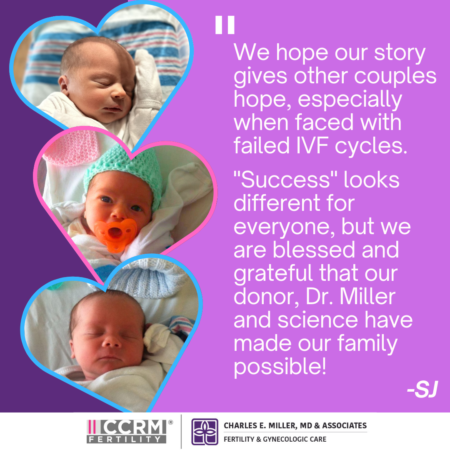
Our journey to build our family was a long one, but we are happy to say we are on the "other side" of infertility thanks to Dr. Miller and his wonderful staff!
We started trying to conceive in May 2009 when I was 29 years old. Both of our parents had conceived easily, and we were both healthy, so we didn't expect to have any problems. Unfortunately, after a year of negative cycles, we started seeing a fertility doctor in June 2010. Despite all our tests looking normal, we did four IUIs that all failed. When we finally got to the point of doing IVF, we just expected it would work. Our first IVF cycle, I got pregnant and for the first time ever saw two pink lines! Even though my hcg numbers were low, I thought just the fact that I'd finally seen a positive pregnancy test meant things might work out. We lost the pregnancy around 5.5 weeks and quickly moved into a frozen embryo transfer (FET). That cycle failed, and we did two more IVF retrieval cycles and fresh transfers that both failed. After our third failed IVF cycle, my original fertility doctor suggested that we may need to use donor eggs. I was not ready to move forward with donor eggs then, so we tried one more IVF cycle with our original doctor. When that cycle failed, our doctor suggested not only donor eggs but donor sperm. We asked our doctor if he would be willing to perform further testing and a laparoscopy to test for endometriosis, since my sister had recently been diagnosed with it. When he refused, we decided it was time to switch clinics.
I had a friend who was able to get pregnant after a procedure Dr. Miller performed, so based on her recommendation and a lot of research, we decided Dr. Miller's office was the right place for us to continue our journey. Dr. Miller was completely on the same page as us and understood that before we did donor eggs or donor sperm or another IVF, we wanted to be 100% sure we had tested for any potential issues like endometriosis or immune issues that could affect implantation of an embryo. Our motto was "no regrets," so we wanted to make sure we had no regrets about our decisions on this fertility journey. Dr. Miller performed a laparoscopy after finding mild endometriosis, and he discovered I had homozygous MTHFR, both issues he thought could affect IVF success. We tried one more IUI cycle and one IVF cycle with Dr. Miller. After our first IVF cycle with Dr. Miller, he told me I had "soft" eggs and recommended donor eggs. He said he did not think we needed donor sperm, but he showed us the statistics on donor eggs and explained how such a cycle would work. Dr. Miller's Donor Egg IVF Coordinator also gave us a lot of information on donor egg agencies and counselors.
After taking a few months to regroup and make sure we were ready, we decided to move forward with donor eggs in August 2012. Dr. Miller also added Lovenox and Medrol to my cycle due to my MTHFR and repeated IVF failures. We found an amazing donor egg agency (Graceful Conceptions) and moved forward with a fresh donor egg cycle in December 2012. The difference between our donor egg cycle and my egg cycles was night and day! We had so many more embryos to work with that we did with my cycles, and they were all top quality! We transferred two embryos on December 18th and were able to freeze five more high graded embryos. And right before Christmas I got two beautiful pink lines on a pregnancy test! It was the BEST Christmas gift we could ever imagine! We found out two weeks later that we were expecting not only one but TWO babies!
Our twins were born healthy in 2013, and we kept our frozen embryos for several years. Eventually, in 2022, we decided to try and expand our family. We knew it might take a few tries, but we got lucky and had success on our second frozen embryo transfer in May 2022.
We know some people are not comfortable with donor eggs, but Dr. Miller made us feel so comfortable about it, and he reminded me that with donor eggs I would still be carrying my children. We know our three beautiful children would never have been possible without donor eggs or Dr. Miller. We are forever grateful we decided to switch clinics back in 2012, and we are thankful Dr. Miller was so straightforward about donor eggs being our best chance of having a baby and building our family. We explained to our kids that donor eggs are just part of their story and something that makes them special, and they will always know how much they were wanted and loved! We hope our story gives other couples hope, especially when faced with failed IVF cycles. "Success" looks different for everyone, but we are blessed and grateful that our donor, Dr. Miller and science have made our family possible!
-SJ

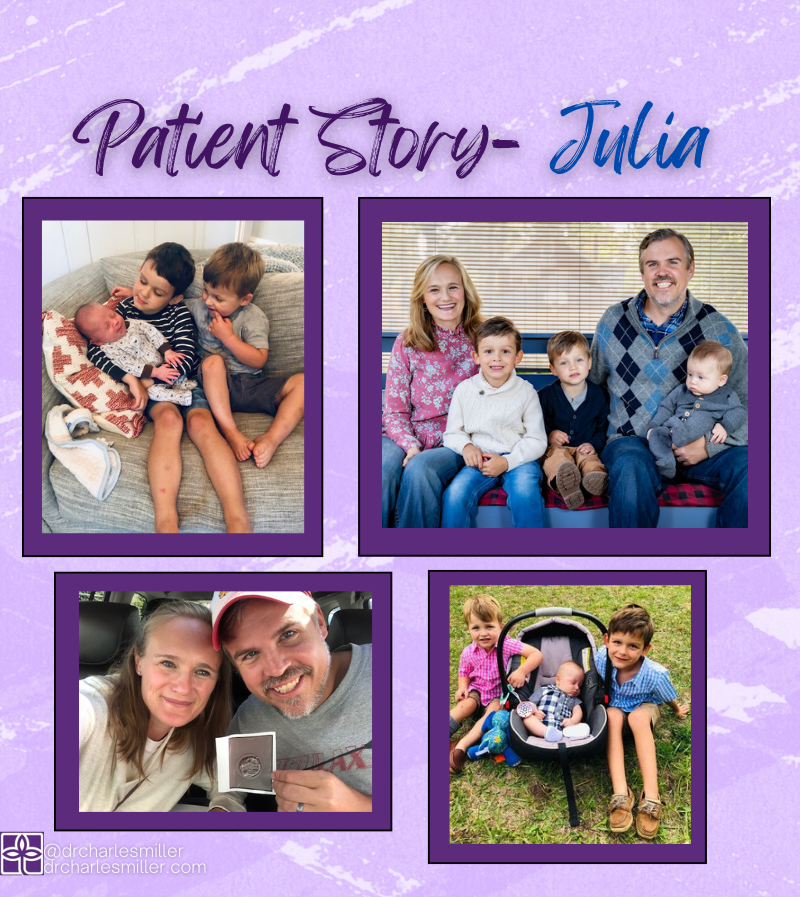
Patient Story- Julia
“This is why you keep fighting; so that you can have peace. Whatever outcome will bring you peace, that is what you fight for.”
Julia is a patient that our office has known for quite some time. She recently welcomed her third baby boy and we have enjoyed getting updates and pictures throughout the years. A seasoned IVF veteran, Julia has been through it all and yet she is incredibly candid about her experience. This openness has led her to volunteer to answer calls for the Resolve support line twice a month. While there aren’t many calls, she is so grateful when she gets to speak to someone and give them some hope. We are so grateful that Julia has shared her story.
She writes:
The other day, I took my two older boys to the fire station open house. It was absolutely packed, it seemed like everyone from our town was there. I looked around at all of the children, moms, dads, siblings, grandparents, etc. and had a moment of self-doubt.
“I don’t belong here,” I thought to myself. “This event is for families.”
As if on cue, my middle son reached up to hold my hand, and my older son ran ahead and called out for me. “MOM! This way, follow me!”
I was instantly brought back to reality, my feelings of insecurity disappearing and belonging restored. I am a mom (of three boys!), and I DO belong at family events, school drop-off, parent-tot classes, parks and baby pools, and in the club that is Parenthood.
The lingering grief and pain of infertility can rear its ugly head at the strangest moments, like it did that Saturday morning. I remember the feeling of fear so well; the fear that I would never become a mom. I know all too well how painful the treatments and the unknowns are as I fought long and hard for my boys. However, I also know the peace that comes from a dream achieved. I want to instill hope in anyone who has that fear and pain, who is in the throes of fertility treatment, who is struggling with self-doubt and the unknown.
I have three beautiful and healthy boys. They are almost perfectly spaced apart; 2.5 years. From the outside looking in, we are a very typical family. And in most senses, that is correct – except for how our family was created.
We waited four years for our first son. I worked for one year with my ob-gyn and Clomid. I then had six stimulated rounds with my first fertility specialist and one miscarriage. When I met Dr. Miller, I had two more failed IVF rounds before we chose to use a donor egg. I had a polyp removal surgery. I did three trial cycles to determine the optimal window for an embryo transfer. We lost our first donor due to poor response to stimulation while I was on hormones alongside her. With our second donor, my first transfer was a blighted ovum that ended in two separate D&C surgeries. After extensive blood work, I was diagnosed with MTHFR, a genetic blood-clotting disorder that can affect implantation.
On November 9, 2016, my 13th cycle, I became pregnant with my first son.
Charlie was cycle 13. James was cycle 15. John was cycle 16.
I share the details of my journey not to overwhelm you, but to give you strength. Maybe your journey will be shorter than mine. Maybe it will be longer. It often felt daunting, hopeless at times, and never-ending. I remember the receptionist at Dr. Miller’s office pulled out my file. It looked like several copies of the Yellow Pages stacked on top of each other. During one of my meetings with Dr. Miller, he put his hand on top of that file and said, “Julia. We haven’t been through this much, for you to not get pregnant. I WILL get you pregnant.” I trusted him and pushed forward despite the fear and pain.
This is why you keep fighting; so that you can have peace. Whatever outcome will bring you peace, that is what you fight for. And you will know when that time comes. People ask me how I did it. They want to know how I managed the appointments and driving, the shots and tests, the physical side effects and emotional trauma, the disappointment and the grief.
I tell them the truth; you just do it. You have to keep going so that you can have your peace.
I promise that the grief and fear will fade with time. It might make an appearance here and there after you have achieved your dream, but that is just a little bit of PTSD from the journey. It will fade. You will hold your little miracle, you will walk with your child at the fire station open house, or into that parent-tot gym class, or to the first day of preschool, or story hour at the library and you will belong. You will feel peace.
Believe in Dr. Miller. Believe in his nurses, the ultrasound techs, the phlebotomist, his entire staff. Throw in some prayers, push forward, and wait for your time to come.
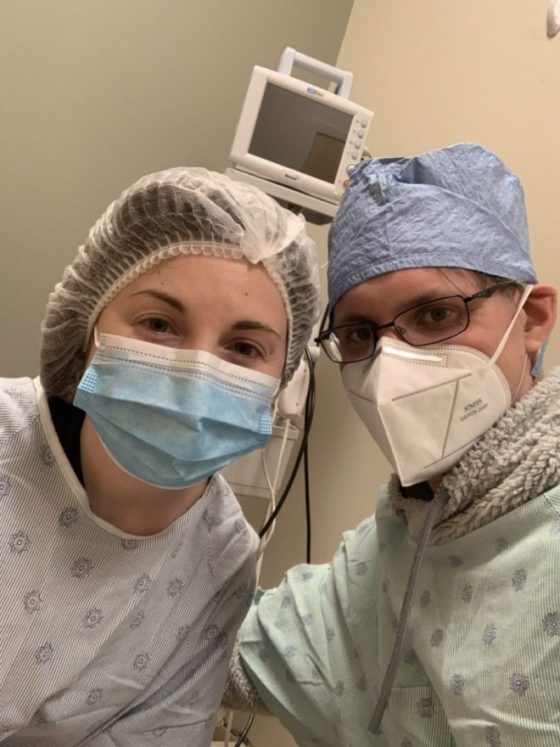
Patient Story- Rachael
“Our plan was always to have a baby, but our path certainly wasn’t a straight line.”
Our next patient story is from Rachael. Rachael’s journey to motherhood has not been an easy one. After undergoing several unsuccessful rounds of IVF, Dr. Miller advised Rachel to consider using an egg donor. In her story, Rachel describes the process she and her husband went through to choose an egg donor and what advice they would give to others in her situation. Rachael’s story has a happy ending- she is now pregnant and due with a baby boy in February!
Rachael writes:
To say that our journey was a difficult one is an understatement.
I was 34 years old when we wanted to start our family. After six months of trying on our own, we met with Dr. Miller. Testing and medication followed, and we eventually discovered – after finding out I had a diminished ovarian reserve, as well as confirming that I had a unicornuate uterus – that IVF was a route we needed to take. We diligently went to work ordering medication, setting up appointments, and saying so many prayers. Unfortunately, our first round failed. We just kept thinking, “This is it!” only to find ourselves back at square one.
When I met with Dr. Miller for our follow-up consult, he had another plan to try again. Upon leaving our meeting, he told me, “Stick with me, Rach! Rome wasn’t built in a day.” Knowing this was true, and knowing we had faith in our doctor, we trudged ahead and kept going. What followed were an additional five rounds (some stopped before retrieval), further testing and added medication, laparoscopic surgery, and the need to put on more weight in hopes that it would help my egg quality.
After several additional rounds of IVF and additional embryos from said rounds that didn’t take, our insurance plan was running out of options for us to keep moving forward. Dr. Miller advised us not to do the egg retrieval with my own eggs at that point and suggested turning to an egg donor. We were absolutely heartbroken. We knew that this was a real possibility, but the news was hard to take in. We were at the end of stimulation injections, and my body just wasn’t cooperating (which had happened during another of our previous cycles). Knowing my track record, Dr. Miller was concerned that this round would not work and then we’d really be out of options with my insurance. We converted the round to an IUI, but it didn’t take. A month later we transferred the one frozen embryo we had (insurance would still cover that), but we were left with a negative result.
We were angry, frustrated, and beyond depressed. We knew it was no one’s fault (I had to keep reminding myself that I did nothing wrong), but we couldn’t understand why it was happening. We did absolutely everything we possibly could to have a positive outcome, but were left with nothing but grief. You know everyone means well when they offer their condolences, but there are times when IVF is an incredibly isolating experience.
A few months later, we met with Dr. Miller again to discuss using an egg donor. He answered all our questions and felt optimistic about this new plan. When we were ready, we contacted an agency to get information. Later that fall, we chose our egg donor and started to feel more optimistic ourselves. Our donor went through the testing process and started some medication. We had psychological evaluations to make sure that everyone was in the right state of mind to go through this process, and we met with a lawyer to go through the contingencies of everything.
Our donor finally had her egg retrieval in February; we received 48 eggs (which was incredible!), and out of the 48, we had 17 embryos to freeze. We couldn’t quite sync up cycles, so we worked toward an April transfer, but then that got canceled due to me catching COVID-19. We were finally able to complete our transfer in May, and at the end of the month we received our first positive pregnancy test! I’m due in early February with a boy and am currently 18 weeks along (for a frame of reference, I am now 39 years old).
Moving forward, we have 16 embryos at our disposal. Besides some days where I didn’t feel great in the first trimester, my energy has bounced back in the second trimester and I feel pretty good! We’re really looking forward to the future and still cannot believe that we’re on the other side after years of wondering “what if?”
It was a long, difficult four-and-a-half years to get to this point. There were so many tears, early morning appointments, and hours upon hours of frustrating phone calls with insurance and pharmaceutical companies. There were so many pregnancy announcements by friends and family. There were so many times when we felt raw, numb, and alone. But on the other hand, we had hope. We had a strong support system, and we had a caring doctor who genuinely wanted the best for us. Dr. Miller’s staff was so kind and offered me hugs on more than one occasion when we received bad news. We learned to give into the unknown (something difficult for us teachers to do) and trust that we were doing everything we could.
If I can offer advice, I’d stress the importance of learning to pivot. Our plan was always to have a baby, but our path certainly wasn’t a straight line. We had to adjust the details of our dream, but that doesn’t mean that we’ll be any less of parents than we would have if things had worked with my genetics. Our dream could still be a reality, but adjustments were needed. Keep the end goal in mind: if it’s to have a child, understand that what that means might look different than what you anticipated when you started the journey.
If you find yourself in need of an egg donor (or sperm donor, if that’s the issue), I’d encourage you to take your time and go through the process when you’re ready. Don’t try to look for yourself in the pool of applicants; you won’t be there, and that’s okay. When we first got information from the egg donor agency, they encouraged us to not pay as much attention to pictures, but to focus on the information: we examined their health history and that of their relatives; we listened to their reasons for being a donor; we screened applications for the possibility of twins and triplets (given my unicornuate uterus, multiple births at one time was not considered a viable option); we also poured over their previous donor cycles to see what kind of success they had.
In the end, we chose someone who looked happy. She genuinely wanted to help other people conceive and assisted others in that goal already. The agency (and Dr. Miller’s office) couldn’t say enough good things about her, which was really reassuring. Besides matching my ethnicity, she does not look like me, but I’m keeping in mind that our boy very well may look more like my husband than the donor. If he doesn’t, that’s okay, too. This was something I had to learn to get comfortable with before we officially went through the donation process.
There are times when I look back at the last few years and the pain comes crashing back, and I’d be lying if I said it was easy to move on from my genetics. However, at the end of the day, the goal is to have a baby, and I learned that it is still possible if my genetics are no longer an option. This could be a path for you, too.
We would also encourage you to let people in and have a support network. My husband and I did not always want to talk about our struggles, but knowing we could speak with family and friends was helpful (and there are other support groups if you aren’t getting the support you need from those around you, too). Even though most of the people you know might not “get” the struggle you’re going through, it’s important to remember how many people are in your corner. You’re going to feel alone. You’re not.
Keep the faith. We’re rooting for you!

Surrogacy and Egg & Sperm Donation- What You Should Know From a Legal Perspective

Finding out you may need to use a surrogate or a egg or sperm donor to build your family can be a confusing and overwhelming time. Not only do you need to think about how the medical aspect will work, but there are legal matters to consider as well.
We asked Meg Ledebuhr, Partner Attorney at the Midwest Fertility Law Group, a few questions about the legal aspects of surrogacy and what you should know before beginning the process.
Q: We have decided to use a surrogate. What steps do we need to take before beginning the medical process?
A: Once a prospective surrogate or intended parent has decided to commit to surrogacy, the next steps are to decide what type of surrogate they will pursue and the specific professionals they will work with.
Intended Parents can proceed with one of two types of surrogacy arrangements: traditional and gestational. In traditional surrogacy, the surrogate is also the biological mother of the child she carries. Her egg is fertilized using sperm from the intended father or a donor using intrauterine insemination. In gestational surrogacy, the child is not biologically related to the surrogate. The embryo is instead created using an egg from the intended mother or a donor and sperm from the intended father or a donor using in vitro fertilization. Once the egg is fertilized in the laboratory, the embryo is transferred to the surrogate.
If Intended Parents and the Surrogate already know each other and determined they are a good fit, they can utilize a surrogacy attorney to complete the legal work and a mental health professional to complete the mental health screening. If Intended Parents and the Surrogate need matching services, they can work with a surrogacy agency to provide matching, in addition to other case management services.
After the Intended Parents and Surrogate have decided to proceed, the clinic will begin the medical screening process.
Q: What do I need to know about surrogacy contracts?
A: Each party to the surrogacy arrangement must first obtain their own attorney (although the intended parent will pay the legal fee for the surrogate’s attorney) and negotiate a contract describing their arrangement. The role of a legal contract is to: (1). Memorialize Intent (2). Deal with contingencies in pregnancy and (3). Allocate risks and rights and responsibilities of the Parties.
There are certain issues that must be covered in any surrogacy contract. The following are points that are regularly addressed when drafting the contract:
(i). The Law of the State
All parties must agree to follow the specific procedural requirements in order to validate a contract and all steps necessary to complete proper parentage paperwork. It is wise to detail these steps in a contract so all parties have an expectation of what will be required of them.
(ii). Identify Medical Providers
Specifically name the IVF clinic, IVF physician, obstetrician and anticipated delivery hospital.
(iii). Medical Process and Number of Cycles to be Attempted
The contract should contain an overview of the medical process. Parties also generally agree to work together for three (3) embryo transfers for a period no longer than 18 months. The number of embryos to be transferred each cycle is also addressed.
(iv). Medical Autonomy
Surrogacy agreements must balance the Gestational surrogate’s right to medical autonomy, while addressing the Intended Parent’s desire to make medical decisions concerning the fetus. At a minimum, the agreement should detail all health precautions each Party agrees to follow before and during the embryo transfer and after a pregnancy has been confirmed.
(v). Parental Obligations
The Intended Parents agree to accept any resulting children, notwithstanding congenital abnormalities, defects, or health problems. This parental obligation should consist of custody and a promise to support the child regardless of the personal or marital circumstances that exist between the Intended Parents at the time of birth.
The surrogate agrees to surrender all parental rights, if any, and to surrender custody of the child to the intended parents at birth.
(vi). Understanding of Risks Involved and Indemnification
The contract should contain a clause regarding an understanding of the medical and psychosocial risks involved and an indemnification clause to insulate the attorneys and parties from liability.
(vii). Abortion and Selective Reduction
This is one of the most crucial areas in matching surrogates and intended parents. It is imperative to do everything possible to make sure all parties are in total agreement on serious decisions like selective reduction and termination of a pregnancy.
(viii). Payment of Prenatal and Birth Expenses
The agreement will provide that the Intended Parents pay for all out-of-pocket medical expenses of the surrogate. Sometimes the contract provides that the surrogate will be paid a monthly allowance of approximately $200 which will be used to cover co- pays, mileage, and other miscellaneous expenses.
(viv). Compensation
Every agreement should contain a statement that any payment to the gestational surrogate is not payment for the child him or herself, as the child commodification (or baby-buying) is illegal in every state in the United States. Payment provisions should specify the exact amount of payments being made, whether they are contingent on certain events and when each payment will be earned. For a compensated arrangement, the gestational surrogate will often be entitled to base compensation, which is a set fee the gestational surrogate will earn for attempting to carry the child to term. Most agreements provide ten (10) equal monthly payments, commencing at fetal heartbeat and ending at delivery.
Q: What happens if we are using a donor egg or donor sperm?
A: For individuals and couples deciding to have children, sperm donation, egg donation and surrogacy are increasingly popular options. These methods are an effective way to create a family, but certain legal implications need to be understood.
In most cases, when an anonymous sperm or egg donor donates their gametes to an egg or sperm bank, or directly to an IVF clinic, they sign a form releasing them from any parental rights or responsibilities for any child born through their donation. Therefore, when you receive anonymous sperm or eggs from a clinic or gamete bank, the legalities are usually taken care of.
However, if you want to use an egg or sperm donor that you know or one selected by you through a matching entity, you will need to enter into an egg or sperm donation agreement. These agreements are essential because they establish the parties’ intentions and expectations with respect to the donation and, depending on your individual circumstances, the agreement will be important to obtaining a court order securing your legal relationship to your child.
Q: What is second parent adoption?
A: “Second-parent adoption” is when a parent who is not biologically related to the child adopts the child in order to establish or confirm legal parentage. This ensures the parental rights of the non-biological parent are recognized regardless of where the family travels or resides. LGBTQ parents cannot currently rely on recognition of their adult relationships (e.g. marital, civil union or domestic partnership presumptions) as the basis for recognition of their relationships with their children.
“Second-parent adoption” is when a parent who is not biologically related to the child adopts the child in order to establish or confirm legal parentage. The second-parent adoption procedure ensures that the parental rights of the non-biological parent are recognized regardless of where the family travels or resides. LGBTQ parents cannot currently rely on recognition of their adult relationships (e.g. marital, civil union or domestic partnership presumptions) as the basis for recognition of their relationships with their children. Second-parent adoption in Illinois is a very efficient and cost-effective way for parents to establish an independent legal relationship with his or her child that does not depend on recognition of her/his relationship with her/his spouse/partner.