
How Uterine Fibroids Can Affect Your Fertility
Did you know that 30% of all women have fibroids by the time they’re 30? While fibroids are incredibly common, for some women, they can be a cause of infertility, especially when their location affects the uterus. We asked Dr. Charles E. Miller to help us better understand how fibroids affect fertility and the recommended treatment options.
Why Fibroid Location Matters
The problem lies in where the fibroids are located. Fibroids in the uterine cavity or near the cavity are particularly concerning when it comes to fertility.
In the past, we always recommended surgery for women with fibroids in the cavity. But over the years, we’ve learned that fibroids near the cavity can be just as problematic.
Back in the 1990s, I conducted a study on women who were either miscarrying or unable to get pregnant and had fibroids within 4mm of the endometrial cavity. After surgery, 70% of them went on to have a successful delivery.
Treatment Options for Fibroids
Surgery remains the primary mode of treatment for fibroids that need to be removed. The approach depends on the size and location of the fibroid:
- If the fibroid is in the cavity or small and close to the cavity, we typically remove it using a procedure called hysteroscopy. This involves placing a small telescope into the uterus and removing the fibroid without any incisions.
- When the fibroid is firmly in the muscle wall or is larger, it needs to be removed laparoscopically. At our practice, we take great pride in performing these procedures minimally invasively.
Unfortunately, at other places, fibroids are sometimes removed via a mini laparotomy, a small but still open incision, similar to a C-section cut. My concern with this method is that it increases the risk of scar tissue, which can further impact fertility.
The Bottom Line
If you’re having trouble achieving a successful pregnancy and you have fibroids, don’t wait. Seek out a specialist with the expertise to evaluate and treat those fibroids properly.
I absolutely recommend a hysteroscopic or laparoscopic approach whenever possible. It’s effective, minimally invasive and gives women the best chance at a healthy pregnancy.

May 10 is Dr. Miller Day!
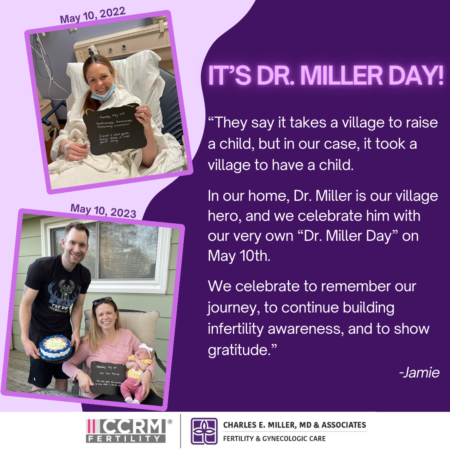
Did you know May 10th is Dr. Miller Day? Neither did we, until our patient, Jamie, shared that she created this special day to remember her fertility journey, the support she received from her “village” and of course the doctor who helped her become a mom!
Jamie writes:
Our fertility journey started as most do, with a lot of hope and a lot of disappointing negative pregnancy tests. During my initial testing, I found out I had 2 fibroids and one was very large. Although I kept asking about the large one, I was told by 3 different doctors that they weren’t an issue and was encouraged to start IUI or IVF.
Although reluctant, we started planning on how and when to move forward. Through that process, we started applying for grants. While looking at the grant application, I started reading into how it would be scored. In the fine print, I noticed certain types of fibroids would disqualify us from the grant, and that is because they can make IVF less successful. This made me, once again, question my fibroid. I told my husband that I wanted to find an expert opinion to rule out the fibroid causing my fertility issues before beginning any treatment. I started to research fibroid experts, and one name kept coming up again and again in my search, Dr. Charles Miller.
In April 2022, during my consultation with Dr. Miller, I expected to hear, once again, that the fibroid was “fine.” Dr. Miller recommended surgery, and on May 10th, 2022 he successfully removed both fibroids. We spent the next few months healing, trying to enjoy life, appreciating what we have, and planning our next steps to bring home a baby of our own.
In August 2022, I returned to Dr. Miller’s office, and he told me that things healed well and we could start trying again. During that same month, I was on pins and needles hoping to hear that we got the IVF cycle grant. However, less than three weeks after my follow-up visit with Dr. Miller, our jaws dropped when we got our positive pregnancy test! It was clear that the fibroid was what had been causing my infertility, and if we hadn’t done our research and sought out Dr. Miller’s expertise, we would have spent thousands on IVF without any success.
On April 17, 2023 our miracle baby girl, Fontana, was delivered via c-section. We cannot thank Dr. Miller enough for taking his time to listen to our concerns, truly evaluating the fibroid and its impact, and for his flawless surgery. Without Dr. Miller, we wouldn’t have had a first birthday to celebrate last month.
This Friday we will celebrate our second Dr. Miller Day. This year we took the time to reflect and appreciate those who were a part of our village by writing cards to family, friends, and those strangers who supported us during our darkest days of infertility. Each person is represented by a house, and when we put them all together, it was empowering to see just how many people helped us along the way. No two infertility journeys are the same, but for those still in the trenches, trust your gut and advocate for yourself.